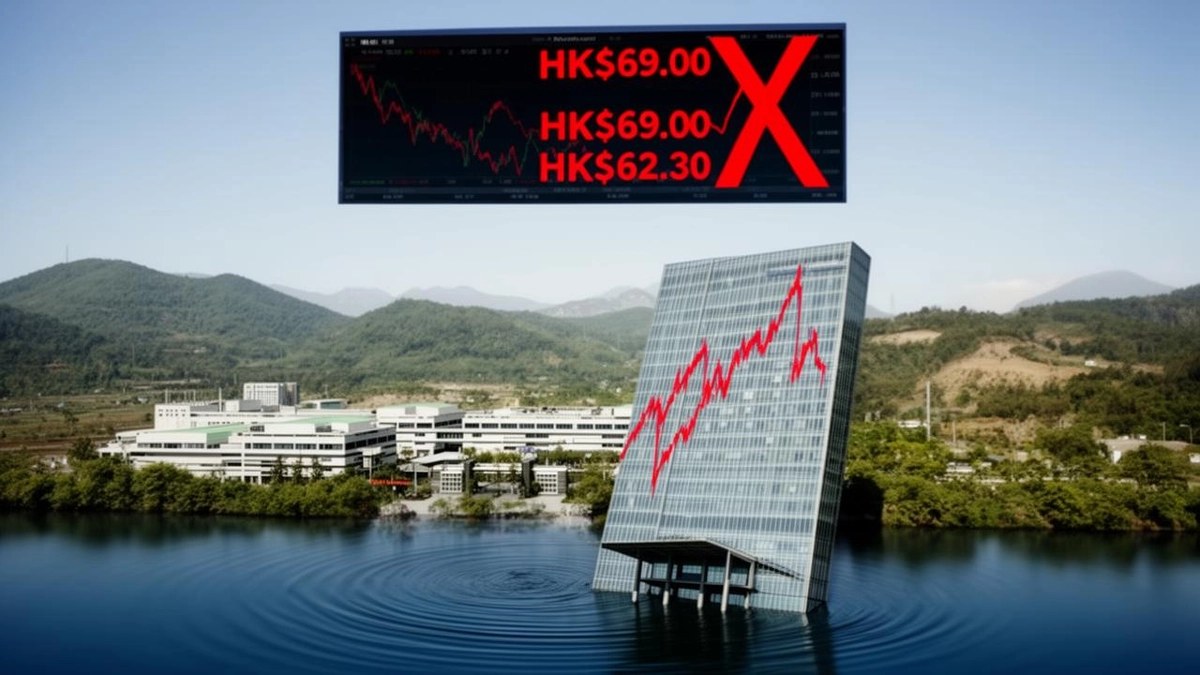
Luxshare Precision Industry (02475.HK), one of Apple’s most critical assembly partners, stumbled out of the gate Thursday in its Hong Kong trading debut, with shares sliding as much as 9.6% despite the company pricing the year’s largest initial public offering in the city at HK$24.3 billion ($3.1 billion). The break below the offer price underscored a growing wariness among investors confronting a wave of richly valued Chinese technology listings and an increasingly volatile global market backdrop.
Shares opened at HK$63.25, just a hair below the HK$63.28 IPO price, and quickly lurched lower to an intraday trough of HK$57.20 before paring losses to close at HK$62.30, down 1.6%. The Shenzhen-listed shares (002475.SZ) moved in the opposite direction, climbing 3.2% to 64.46 yuan, widening the premium over the Hong Kong stock to roughly 19%.
The debut marks a sobering start for the Shenzhen-based electronics manufacturing services giant, which has spent two decades evolving from a connector maker into a global platform that builds everything from AirPods and iPhones to automotive wiring harnesses and AI server interconnects. Founded in 2004 by former Foxconn assembly-line worker Wang Laichun and her brother Wang Laisheng, the family-controlled company has ridden Apple’s product cycles to become a roughly $80 billion enterprise.
Luxshare’s revenue surged 24% in 2025 to 332.34 billion yuan ($48.9 billion), with net profit climbing 24.6% to 18.17 billion yuan, according to its listing prospectus. Consumer electronics still dominate, contributing 79.5% of the top line. But the company is pushing hard to reshape its narrative, directing capital toward automotive electronics, which accounted for 11.8% of revenue, and communications and data centers at 7.4%. The automotive unit in particular has exploded, with revenue rocketing 185% to 39.26 billion yuan in 2025.
A cornerstone investor roster studded with global heavyweights—Temasek Holdings, GIC, Abu Dhabi Investment Authority, Tencent Holdings (TCEHY), HHLR Advisors, and Millennium Management among them—committed roughly $1.5 billion to the offering, yet their presence wasn’t enough to prevent the stock from sinking below the listing price. Retail investors who participated in the public tranche, which was 3.78 times subscribed, were left nursing a paper loss of roughly HK$278 per board lot of 100 shares.
“The underperformance of some new listings likely reflects a more cautious market backdrop and broader uncertainties surrounding global trade and geopolitics,” said Chokwai Lee, a director at Morningstar, adding that investors are becoming more selective about richly valued companies and more cautious on the pace of AI adoption following a recent pullback in chip stocks.
Luxshare’s lukewarm reception was not an isolated event. Six other companies debuted in Hong Kong on Thursday, and most drew a tepid response. Electronic test equipment maker Rigol and circuit-board tool maker DTech both slid below their offering prices. E-paper display maker DKE and ceramic electronic parts maker CCTC posted only modest gains. Qiyunshan Food was a standout, briefly surging nearly threefold, while Rokae Robotics advanced 15.2%.
The broader Hong Kong IPO market is navigating choppy waters. A record wave of lock-up expirations following a strong first half for new listings is casting a shadow over secondary trading. MiniMax Group plunged as much as 18% on Thursday as its first large post-listing lock-up period expired, freeing roughly 45% of its issued share capital for public trading. The heavy supply of new paper—first-time offerings in Hong Kong have raised more than $30 billion so far in 2026, closing in on the $36.8 billion full-year total for 2025—is forcing fund managers to pick their spots more carefully.
Luxshare’s deal vaulted past Victory Giant Technology’s $2.9 billion April debut to become the city’s largest listing this year. It also arrived in the same week that autonomous-driving startup Momenta and Chinese chip foundry Nexchip Semiconductor priced their own Hong Kong offerings, with Nexchip raising about HK$6.98 billion.
Behind the IPO lies a straightforward but expensive ambition: to fund a global manufacturing footprint that can serve customers far beyond Cupertino. The company plans to channel about 35% of the proceeds into expanding and upgrading production bases, including facilities in Vietnam, India and Mexico. Another 30% is earmarked for research and development and smart manufacturing, while the rest will go toward industrial investments, working capital and debt repayment.
That capital injection arrives at a critical moment. Luxshare’s operating cash flow turned sharply negative in the first quarter of 2026, swinging to a deficit of 7.07 billion yuan from a positive 3.61 billion yuan in the first quarter of 2023. Short-term borrowings swelled more than 70% to 60.1 billion yuan by the end of 2025, even as total assets expanded 37% to 306.5 billion yuan. The balance sheet tells a story of a company sprinting to build capacity for a future it believes is coming, even as the bill weighs on current liquidity.
The company has also been using acquisitions to accelerate its transformation. In April 2026, it raised its controlling stake in German automotive cable and harness specialist Leoni AG to 74.9%, deepening its push into a sector where margins are structurally higher than in consumer electronics. Automotive electronics gross margins reached 15.75% in 2025, compared with 10.64% for consumer electronics and 18.40% for communications and data centers.
Yet for all the diversification rhetoric, Apple remains the gravitational center of Luxshare’s business. PitchBook data indicates the iPhone maker still accounts for approximately 70% of revenue, though the company’s prospectus showed that reliance on its largest customer has fallen from 75.2% in 2023 to 56.7% in 2025. The distinction likely reflects how the company defines its customer relationships, but the directional trend is clear: Luxshare is methodically reducing its dependence on a single partner while building out higher-margin revenue streams.
The question hanging over the stock is whether investors will reward that transition before the new businesses reach sufficient scale to move the needle. Communication and data center revenue, while growing 33% to 24.57 billion yuan in 2025, remains roughly one-tenth the size of the consumer electronics segment. AI server interconnects, high-speed connectors, liquid cooling and optical modules are all areas where Luxshare has established beachheads, but none has yet matured into a profit engine capable of offsetting the cyclicality of smartphone assembly.
Lukman Leong, an analyst at Doo Financial Futures, told Reuters that Luxshare’s Hong Kong IPO was well-timed to capitalize on strong investor enthusiasm for AI and tech supply chains, while highlighting the city’s renewed appeal as a fundraising hub for Chinese firms. The stock’s first-day performance suggests that enthusiasm is now being tempered by a more discriminating market.
Wang Laichun, whose journey from factory floor to chairwoman has become emblematic of China’s manufacturing ascent, struck a long-term tone at the listing ceremony. “The company will adhere to long-termism, continue to innovate based on our core business, and solidify our core competitiveness to empower global customers with better products and services,” she said. Her personal fortune now ranks first in Shenzhen and second nationally among self-made women, according to the 2026 Hurun Global Self-Made Women Entrepreneurs List.
The Hong Kong listing gives Luxshare a second equity currency and a platform to attract international institutional capital as it competes for contracts in automotive and AI infrastructure—markets where scale, local manufacturing presence and balance-sheet strength are increasingly decisive. Whether the stock’s soggy debut proves to be a temporary mispricing or a signal that the market has grown impatient with the pace of transformation will depend on how quickly those overseas factories ramp up and start converting capital expenditure into earnings.